
The evidence
Most of us
never realize.
The driver
70%
Emotion runs the room.
Of every decision you make, about 70% is driven by emotion. Not logic. Not data. Not strategy. Emotion. It does not matter what industry you are in, what degree you hold, or how long you have been at the table. The driver is emotional. Whether you know it or not.
What school gave you
Zero.
Twelve years.
Not one lesson.
Not one lesson.
You learned algebra. You learned grammar. You learned the periodic table. You learned not one thing about what to do when your body is flooded with a feeling you cannot name, in a room you cannot leave, with people who are counting on you to lead anyway.
The way out
90%
The highest performers
share one thing.
share one thing.
Nine in ten people who perform well and burn out less are not the least emotional people in the room. They are the most intelligent about their emotions. That is not softness. That is precision. That is the skill no one taught you and the one that changes everything when you finally have it.
"Leave your feelings at the door."
This is what we were all told, but emotions were never the problem. Not having capacity for them was.
Say It Soft Society was built to close that gap.
Why language
The right word
changes everything.
Naming what you feel is not venting. It is a precision act with measurable consequences for how you think, decide, and lead.
When you can name it, you can move with it instead of being moved by it.
90s
Ninety seconds. That is how long a physiological emotion lasts in the body. What keeps it going longer is the story you tell yourself about it, a story that sharpens when you have the right word for what you are experiencing.
Source: Dr. Jill Bolte Taylor, "My Stroke of Insight" (2008). Viking Press.
30%
Affect labeling, the act of naming an emotion, reduces activity in the amygdala by up to 30%. The brain calms when the word arrives. Language is not a reaction to the feeling. It is a regulator of it.
Source: Lieberman, M.D. et al. (2007). "Putting Feelings Into Words." Psychological Science, 18(5), 421-428. UCLA.
27+
Distinct emotional states have been identified in peer-reviewed research. Most people work with five to seven. The gap between what you feel and what you can name is where emotional intelligence either grows or stalls.
Source: Cowen, A.S. and Keltner, D. (2017). "Self-report captures 27 distinct categories of emotion." Proceedings of the National Academy of Sciences, 114(38).
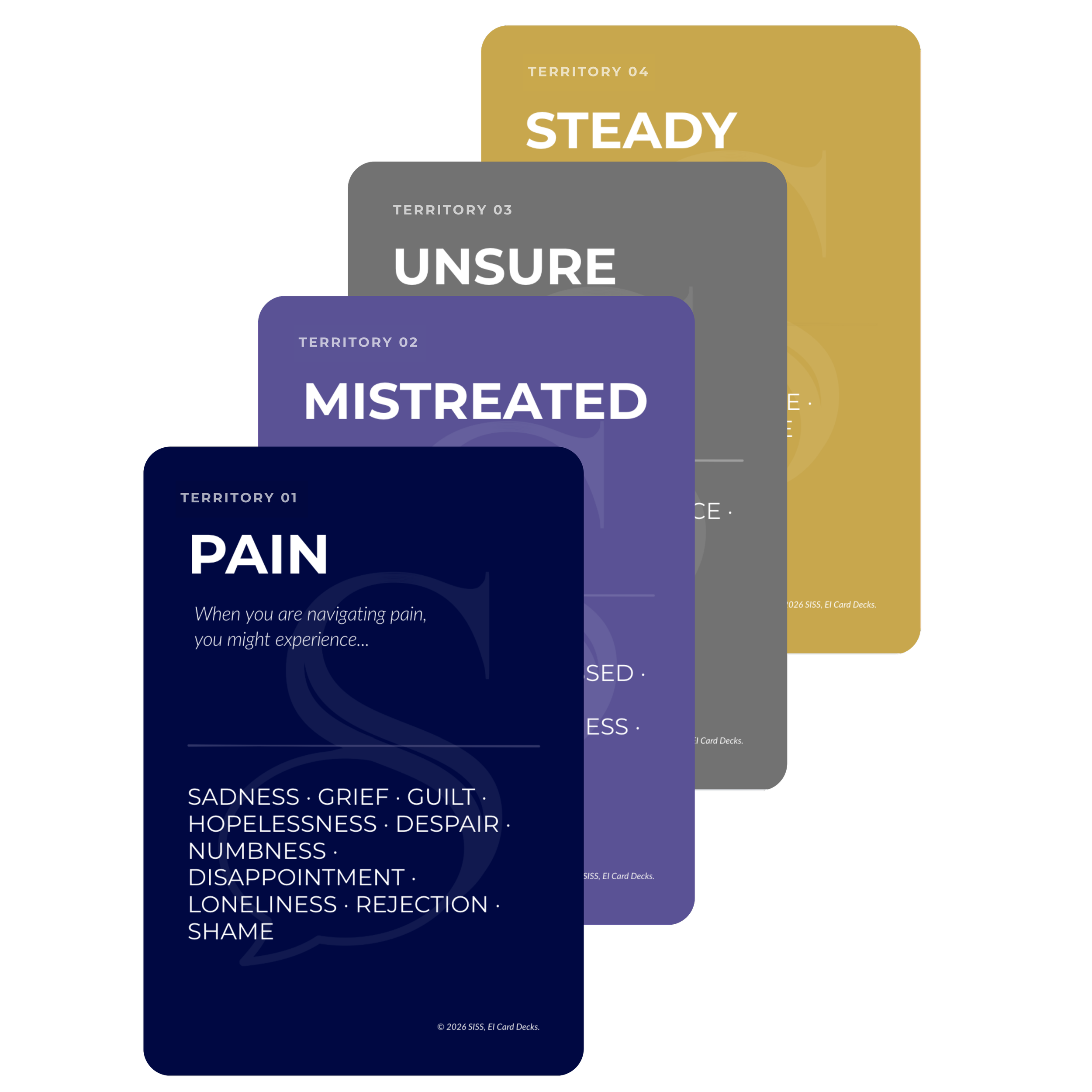
Start with the language that keeps you in command.
The EQ Language Deck is your first step.